



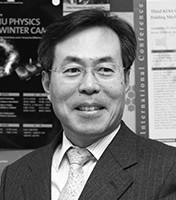
2018 Natural Sciences Laureate
Jong Hae Keum
CV
Bachelor of Science, Seoul National University
Ph.D., University of Michigan
Assistant Professor, University of Utah, Salt Lake City
Professor, Department of Mathematics and Mathematics Education, Konkuk University, Seoul
Professor, School of Mathematics, Korea Institute for Advanced Study (KIAS), Seoul
Visiting Professor, Princeton University
President, Korea Institute for Advanced Study (KIAS), Seoul
MSRI Fellow, Berkeley, California, USA
JSPS Fellow, Nagoya University, Japan
Royal Society Fellow, University of Warwick, UK
Chief Coordinator, 41st International Mathematics Olympiad (IMO 2000)
Member, National Committee for Promotion of Basic Research
Member, Korea Academy of Science and Technology (KAST)
- Member, Selection and Evaluation Committee, Institute for Basic Science (IBS)
- Member, Scientific Committee for International Congress of Mathematicians (ICM 2014)
- Co-chair, Evaluation Committee, Samsung Science & Technology Foundation
- Invited Speaker, International Congress of Mathematicians (ICM)
Reason for Award
Among the various fields of mathematics, algebraic geometry is recognized as one of the most competitive areas for South Korea on the global stage, and Professor Jong-Hae Keum of the School of Mathematics at the Korea Institute for Advanced Study (KIAS) is a leading scholar driving this field. After completing his Bachelor of Science at Seoul National University, Professor Keum earned his Ph.D. from the University of Michigan in 1988. He then served as an assistant professor at the University of Utah before returning to Korea to dedicate himself to education and research as a professor at Konkuk University.
In 2000, in recognition of his research achievements, he was invited to join KIAS as a professor, where he continues to contribute to this day. From 2013 to 2016, he served as President of KIAS, playing a major role in elevating Korea’s basic science research to a world-class level. Over more than two decades, Professor Keum solved the long-standing problem of classifying the finite symmetry groups of K3 surfaces defined over finite fields, publishing his work in the prestigious journal Annals of Mathematics and establishing his exceptional research record.
Through these achievements, he has been recognized as an international authority in algebraic geometry, particularly in the areas of algebraic surfaces and positive characteristic geometry. As a result, in 2018, he was the only Korean mathematician invited to give a plenary lecture at the International Congress of Mathematicians (ICM 2018, Rio de Janeiro), which is held every four years.
Professor Keum continues to actively pursue international research on unresolved problems in algebraic geometry and serves as a referee for one of the top mathematics journals, Inventiones Mathematicae. Given his position at the pinnacle of the mathematical community and his ongoing contributions, Professor Jong-Hae Keum is selected as a final candidate for the 14th Kyung Ahm Prize.
Acceptance Speech
I am deeply honored to receive the Kyung Ahm Prize, which embodies the noble vision of Mr. Kyung Ahm Song Geum-Jo to contribute to national development and human society through nurturing talent, promoting scholarship, and fostering culture. This overwhelming joy of receiving the Kyung Ahm Prize is intertwined with a sense of humility, as my research achievements are still modest. I sincerely thank my colleagues in the mathematical community who recommended me and the jury members who have deeply evaluated my work.
The mathematics I study and research concerns the properties and structures of numbers and shapes. Just as the universe has spacetime, a four-dimensional space is one of many geometric objects. While various disciplines tend to adopt and expand mathematical methodologies, what distinguishes mathematics is the need for proof. In mathematics, listing numerous correct examples or performing experiments is not enough; a proof must be logically and a priori established. This tradition of proof has been consistently maintained since Euclid wrote Elements of Geometry 2,300 years ago. Mathematical proofs require not only complex calculations and logic but also aesthetic imagination and intuition. Mathematicians constantly seek ways to reduce the tedious labor of computation.
In Euclid’s era, geometry (mathematics) was considered a tool to refine reason in pursuit of the “Idea” and was far from practical use. Mathematicians such as G.H. Hardy (1877–1947) once expressed great pride in the fact that their work would never be applied to worldly purposes. Mathematicians pursue beautiful proofs without regard for practicality. This pursuit of aesthetics is what makes mathematics captivating. Paradoxically, mathematics that once seemed completely useless has now become highly practical, with applications ranging from mobile phones (coding theory), e-commerce security (cryptography), big data analysis, DNA analysis and computational biology, Google search, stock markets (Renaissance Technologies – Jim Simons), to digital movie production (e.g., rendering natural disasters like tsunamis or fires using equations rather than props).
One of my research topics, K3 surfaces, are four-dimensional geometric objects named after three mathematicians—Kummer (1810–1893), Kähler (1906–2000), and Kodaira (1915–1997)—and the name also implies that they are among the most beautiful objects after the K2 peak in the Himalayas. K3 surfaces are one dimension higher than elliptic curves but have not been as extensively studied, because both number-theoretic and geometric perspectives are far more complex and difficult. In 1985, during my second year of doctoral studies, Professor Mukai (Kyoto University) presented a solution to the classification problem of symmetry groups of complex K3 surfaces at the AMS Summer Research Institute. This prompted international scholars to ask whether the classification could also be done for K3 surfaces defined over finite fields. Counterexamples demonstrating that Mukai’s results do not hold over finite fields were proposed by contemporary experts such as Mukai, Beauville, Tate, and Shioda.
In 1993, while visiting the Mathematical Sciences Research Institute (MSRI) in Berkeley, USA, as a fellow, I began independent research and obtained key results that would become crucial to solving this problem. Collaborating with my mentor, Professor Dolgachev (University of Michigan), from 1997 onwards, we developed new research methods, publishing intermediate results in 2001 in the Journal of Algebraic Geometry. Building on this work, I ultimately solved the problem in 2006, with the final results published in Annals of Mathematics in January 2009, one of the most prestigious journals in mathematics.
In my recent research, together with fellow alumnus Professor Borisov (Rutgers University), I solved a 40-year-old problem posed by Mumford in 1979, who had abstractly proven the existence of a “fake” projective plane but left the explicit equations unknown. This achievement has been described by international experts as a “monumental work,” and an international conference analyzing this work is scheduled at CIRM, France, for one week at the end of next February. This problem had also been studied and ultimately abandoned by my doctoral advisor, Professor Dolgachev, so resolving it brought much celebration. Early in this research, emails containing the word “fake” were often filtered as spam by international colleagues, which led to some amusing difficulties.
I have conducted extensive research in algebraic geometry, particularly in algebraic surfaces. My contributions were recognized with the honor of being an invited speaker at the 2018 International Congress of Mathematicians (ICM 2018, Rio de Janeiro), held every four years. I will always cherish the honor bestowed by the Kyung Ahm Foundation and continue to strive to set an example for future scholars.
Finally, I wish to express my heartfelt gratitude to my late parents, who always trusted my decisions and made this moment possible, and to my wife and son, who have patiently supported me despite my busy schedule. Thank you.