



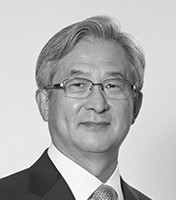
2018 Special Prize Laureate
O Gon Kwon
CV
LL.B., College of Law, Seoul National University
LL.M., Graduate School, Seoul National University
LL.M., Harvard Law School
Passed the 19th Korean Judicial Examination
- Judge, Seoul Civil District Court
- Judge, Seoul Criminal District Court
- Judge, Taegu High Court
- Planning Director, National Court Administration, Supreme Court of Korea
- Research Judge, Supreme Court of Korea
- Presiding Judge, Changwon District Court
- Chair, Press Arbitration Commission, Gyeongsangnam-do Province
- Presiding Judge, Suwon District Court
- Presiding Judge, Seoul Eastern District Court
- Director of Research, Constitutional Court of Korea
- Presiding Judge, Seoul District Court
- Presiding Judge, Taegu High Court
- Permanent Judge, United Nations International Criminal Tribunal for the former Yugoslavia (ICTY), The Hague, the Netherlands
- Vice-President, ICTY, The Hague, the Netherlands
- Member, Independent Panel for the ICC Election, Coalition for the ICC
- Chair, Committee for the Development of Criminal Justice, Supreme Court of Korea
- Chair, Judicial Policy Management Committee, Judicial Policy Research Institute, Supreme Court of Korea
- Member, Board of Editors, Journal of International Criminal Justice, Oxford University Press
- President, International Law Institute, Kim & Chang
- President, Korean Society of Law
- Chair, Advisory Committee on Human Rights Issues in North Korea, Ministry of Justice
- Arbitrator, Korean Commercial Arbitration Board
- President, Assembly of States Parties of the International Criminal Court (ICC)
Reason for Award
Justice O-Gon Kwon is a distinguished international jurist from Korea who has elevated the country’s prestige on the global stage through landmark international legal rulings on war crimes in the former Yugoslavia, Bosnia, and Serbia. During his judicial career in Korea, he was elected in 2001 by the United Nations Security Council as a judge of the International Criminal Tribunal for the former Yugoslavia (ICTY), where he served for 15 years, including as Vice President. He currently serves as President of the Assembly of States Parties of the International Criminal Court (ICC), the highest decision-making body responsible for electing judges and prosecutors, overseeing tribunal operations, approving budgets, and amending the Rome Statute and Rules of Procedure.
Justice Kwon graduated from Kyunggi High School and earned his LL.B. from Seoul National University, where he graduated at the top of his class. He passed the 19th Korean Judicial Examination as the top candidate and completed the Judicial Research and Training Institute at the top of his class. He went on to earn an LL.M. from Seoul National University Graduate School and an LL.M. from Harvard Law School.
After holding key judicial positions in Korea, Justice Kwon, upon his election as an ICTY judge, participated in trials against prominent war criminals, including Slobodan Milošević, former president of the Federal Republic of Yugoslavia, Serbian military officer Popović, responsible for over 7,000 killings, and Radovan Karadžić, a central figure in the Bosnian War. In particular, his role as presiding judge in the Karadžić trial is internationally recognized as a landmark decision, applying advanced legal principles in international criminal law—covering crimes against humanity, joint criminal enterprise, and command responsibility—that have evolved significantly since the Nuremberg Trials.
Since 2007, Justice Kwon has served on the editorial board of the Journal of International Criminal Justice, published by Oxford University Press. From 2010 to 2011, he was a member of an independent panel established by an NGO coalition to evaluate the qualifications of judicial candidates for the International Criminal Court.
After completing his 15-year tenure at the ICTY, he returned to Korea and became the founding director of the International Law Institute at Kim & Chang, focusing on international litigation and legal advisory work. He also serves as President of the Korean Academy of Legal Studies, Korea’s largest and only organization encompassing judges, prosecutors, lawyers, and law professors.
Acceptance Speech
Honorable Kyung Ahm Education & Culture Foundation Chairman Song Geum-jo,
CEO Jin Ae-on and members of the Foundation Board,
Chairman Kim Do-yeon and members of the Kyung Ahm Award Committee,
Distinguished guests,
I am deeply honored to receive the Kyung Ahm Special Award, widely recognized as Korea’s premier academic prize—an accolade whose prestige cannot be adequately conveyed by the word “prestigious” alone.
In truth, I consider myself more a legal practitioner than a scholar. Given that the Kyung Ahm Award is traditionally conferred upon individuals who have not only achieved outstanding academic accomplishments but also actively pursue scholarly work, I feel both humbled and unworthy to accept this honor. Nevertheless, I regard it as an encouragement to contribute to the establishment of the rule of law and the advancement of legal culture in Korea, drawing from my experience at international tribunals, and I pledge to devote myself further to this purpose.
Mechanisms to adjudicate disputes between nations or to resolve compensation claims for wrongful acts have long existed. However, holding individuals criminally accountable for international atrocities, irrespective of state responsibility, only emerged after World War II with the Nuremberg and Tokyo Trials. Over the following fifty years, ad hoc tribunals such as the International Criminal Tribunal for the former Yugoslavia (ICTY) and the International Criminal Tribunal for Rwanda (ICTR) were established, followed by the Special Courts for East Timor, Sierra Leone, Cambodia, Kosovo, and others. Ultimately, this development culminated in the creation of the permanent International Criminal Court (ICC). Notably, this year marks the 20th anniversary of the adoption of the Rome Statute, which serves as the ICC’s founding treaty.
The international criminal justice system now constitutes a crucial pillar of the global legal order. This system reflects the recognition that impunity for atrocities must end and that enduring, sustainable peace cannot be achieved without justice.
My own choice to pursue this path was partly inspired by a sense of historical romance. Just as the martyr Lee Jun, a prosecutor of the High Prosecutors’ Office a century ago, could not enter the Hague Peace Conference, today, no Korean judge has yet served at the International Court of Justice (ICJ) housed in the Peace Palace. I never imagined that this decision would lead me to serve 15 years as a judge at an international tribunal. Participating in globally observed historic trials, striving to establish rational precedents in a new legal field, serving as a member of the tribunal’s senior leadership, witnessing the growing number of Koreans in this field, and ultimately assuming the chairmanship of the ICC Assembly of States Parties responsible for overseeing its operations—all of these milestones give me a modest sense of pride.
In today’s era, “internationalization” is inevitable. Whether we desire it or not, whether a nation desires it or not, international law is already deeply present in our lives. The exercise of jurisdiction by the ICC exemplifies this reality. Korea, too, has recognized international criminal law offenses such as “crimes against humanity” that domestic law alone could not address, and has excluded statutes of limitations for such crimes in accordance with international law.
I believe that globalization requires both “Korea in the world” and “the world in Korea.”
To achieve “Korea in the world,” our legal professionals should not focus solely on domestic concerns but must engage on the international stage and contribute to global peace. This requires providing more opportunities for young legal professionals to gain international experience through supportive institutional measures.
To realize “the world in Korea,” our judicial system must be advanced and aligned with international standards. In today’s interconnected global society, the measure of a country’s advancement is not merely its economic indicators but the state of human rights, judicial transparency, and predictability. While Korea possesses an advanced legal system harmonizing common law and civil law traditions, we must honestly assess whether our judicial practices reflect this sophistication. In doing so, we must continually question the meaning and implementation of our core values, including the “rule of law,” “fair trials,” and the “presumption of innocence.”
Once again, I extend my heartfelt gratitude to the Kyung Ahm Education & Culture Foundation for bestowing this immensely honorable award upon me, despite my limitations. I would also like to take this opportunity to express my deep respect to Chairman Song Geum-jo, who made remarkable decisions for the sustainable development of Korea.
Lastly, I wish to express my sincere thanks to my parents for giving me life and nurturing me, to my parents-in-law for their care, and to my wife, who has always stood by me, providing unwavering support.
Thank you.