



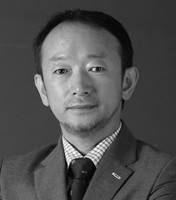
2017 Natural Sciences Laureate
Han Woong Yeom
CV
- B.S. in Physics, Seoul National University
- M.S. in Physics, POSTECH
- Ph.D. in Physics, Tohoku University, Japan
- Research Associate, University of Tokyo, Japan
- Guest Researcher, Linkoping University, Sweden
- Lecturer, University of Tokyo, Japan
- Professor, Yonsei University
- Director, Center for Atomic Wires and Layers
- Director, Center for Low Dimensional Electronic Systems
- Professor, POSTECH
- Director, Center for Artificial Low Dimensional Electronic Systems, IBS
Reason for Award
Professor Han-Woong Yeom is a distinguished physicist representing Korea, who pioneered the field of atomic-scale electron properties and introduced a novel information-processing paradigm known as solitronics. His research achievements are significant both for opening new frontiers in fundamental physics and for providing foundational studies for future emerging industries.
Professor Yeom completed his B.S. in Physics at Seoul National University in 1989, earned his M.S. from Pohang University of Science and Technology in 1991, and received his Ph.D. from Tohoku University, Japan, in 1996. Following this, he worked as a professor and researcher at the University of Tokyo, Japan, and Linköping University, Sweden. From 2000, he served for ten years as a professor in the Department of Physics at Yonsei University. In 2010, he was invited to Pohang University of Science and Technology as a professor in the Department of Physics, where he continues to focus on education and research.
From 2003 to 2012, Professor Yeom served as the director of the Creative Research Initiative on “Low-Dimensional Electron Symmetry.” In 2013, he joined the Institute for Basic Science (IBS), established to promote fundamental science in Korea, as the head of the “Center for Atomic Control of Low-Dimensional Electron Systems,” leading research in this field.
Professor Yeom was the first in the world to observe and theoretically elucidate the intrinsic property of “metal-to-nonmetal transition” in advanced metallic atomic chains, establishing the foundation for this field. Specifically, he discovered that one-dimensional atomic chains consisting of one to four atoms exhibit metallic properties at room temperature but undergo a phase transition below a certain temperature to form an insulating state characterized by a one-dimensional charge density wave. This metal-to-nonmetal transition corresponds to the Peierls instability, a peculiar electronic property theoretically predicted in one-dimensional metals, and is a core property of the organic materials that won the 2000 Nobel Prize in Chemistry.
More recently, he successfully observed the soliton edge state, a one-dimensional topological property within atomic chains after the phase transition, proving that the soliton’s properties constitute a completely new phenomenon called chiral solicon, based on a novel type of topological order. This discovery demonstrates the potential for entirely new mechanisms of information storage and transmission at the single-atom scale.
These research achievements represent scientifically and technologically significant breakthroughs, introducing new concepts in condensed matter physics and serving as a major milestone in the study of solid-state electronic properties. Given the rarity of such accomplishments in Korean physics, Professor Han-Woong Yeom has been selected as the recipient of the 13th Kyung Ahm Award.
Acceptance Speech
First, I would like to express my deepest gratitude to Dr. Geumjo Song, Chairman of the Kyung Ahm Education and Cultural Foundation, and all the foundation staff who selected me as the 12th recipient of the Kyung Ahm Science Award, which was established in 2005 and has quickly become the most prestigious science award in Korea. Having also received the Inchon Award in 2015 and last year’s award, I consider the Kyung Ahm Award an honor far beyond my merits, and it brings an even greater sense of responsibility to my shoulders.
I believe that this award recognizes not so much the excellence of my academic achievements as the sustained dedication to a single line of research I have pursued since my time as an assistant professor at the University of Tokyo in 1996. This research began in 1994 during my doctoral studies at Tohoku University in Japan and has now spanned over 20 years—a deeply moving reflection.
In the laboratory of my doctoral advisor, Professor Kono, I was involved in research on depositing metal atoms on silicon substrates to create single-atom films. I became particularly interested in some of these films that formed one-dimensional atomic chains. Although this work formed part of my doctoral thesis, it did not develop into significant research at that time. Around the time I received my Ph.D. in 1996, I was offered an assistant professor position at the Faculty of Science, University of Tokyo, which is equivalent to today’s junior faculty rank. Amid the busyness of completing my dissertation, one friend made things even more hectic: my first doctoral student, now Associate Professor Daio Matsuda at the University of Tokyo. He sent me an email asking about the research themes of my not-yet-established lab, which made me realize the responsibility of transitioning from student to teacher and the need to define an independent research topic. I organized my ideas into four potential research themes for the three students intending to join my lab, and one of these themes was atomic chain research. In fact, none of the students chose this theme, leaving it for me to pursue independently.
Research progressed slowly at first, but around 1997, I persuaded Professor Shuji Hasegawa from the Department of Physics at the University of Tokyo, and with the help of his student Takeda Sakura, as well as my own student Daio Matsuda, I began the research in earnest. By 1998, we achieved the key results I had anticipated. The moment we observed important data together through nights in the lab remains the brightest moment of my research life. This work was submitted to Physical Review Letters, the leading journal in physics, and was accepted immediately without review, marking its first appearance to the world. This paper became my representative publication and is widely cited as the pioneering work in atomic chain electron structure research.
The modest successes of my research are less a testament to my own abilities than to the passion and dedicated efforts of my colleagues. I would like to express my sincere gratitude to Daio Matsuda, now Associate Professor at the University of Tokyo, and Takeda Sakura, Assistant Professor at Nara Institute of Science and Technology, for initiating this atomic chain research with me. During my time at Yonsei University, Professor Jong-Yeol Ahn of Sungkyunkwan University made a significant contribution to developing this research. In addition, I want to acknowledge the dedication and trust of my students over the past 20 years—including Fumihiko Matsui, Daio Matsuda, and Professor Won-Hoon Choi of Yonsei University—even if I cannot mention every name individually.
After moving to Pohang University of Science and Technology (POSTECH) in 2010, this research reached an even higher level. At the time, I observed that Korean physics research groups were fragmented, centered around individual professors and a few graduate students, which hindered collaboration and limited research development. Unlike U.S. universities, there were no high-level postdoctoral researchers. To overcome this and elevate the quality of our research, I believed it was essential to form a high-level research team composed of professors, assistant professors, and doctoral-level staff, similar to leading labs in Japan and Germany. Several institutions, including Seoul National University, were unable to support this plan, but POSTECH, under President Seong-Ki Baek’s decisive leadership, responded positively, with Director Seung-Hwan Kim assisting in implementing my vision.
As the research team, we welcomed Professor Tae-Hwan Kim, now an assistant professor at POSTECH, and later Professors Sung-Hoon Lee (Kyung Hee University) and Sang-Mo Cheon (Hanyang University). From 2013 to the present, our collaborative research on solitons in atomic chains has elevated my atomic chain studies to a higher level, marked a significant milestone in Korean condensed matter research, and ultimately led me to receive this award.
The model of professors and assistant professors conducting high-level research together as a single group was the first of its kind in Korea’s physics community. It has now been institutionalized in the Institute for Basic Science, in which I also participate. I am deeply grateful to everyone who made these new initiatives possible. Modern scientific research relies heavily on state-funded grants, and I wish to express my sincere appreciation to the funding institutions that have continuously supported my research since my return to Korea in 2000, as well as to those who evaluated and encouraged this support. Their assistance has enabled me to achieve research results at the appropriate time, for which I am extremely grateful.
I hope that Korea will continue to cultivate young scientists, enabling students to dream of becoming researchers, and that society and the government will sustain their attention and support, so that Korea can achieve the many Nobel Prizes akin to Japan. Encouraged by your support, I will continue to strive for excellence in my work.
In this context, I wish to pay deep respect once again to Dr. Geumjo Song, who established the Kyung Ahm Foundation and the Kyung Ahm Science Award. I am confident that your efforts will be fully rewarded through the advancement of science in our country.
Finally, I extend my heartfelt gratitude to my wife, who has always been by my side, and wish my mother continued good health.