



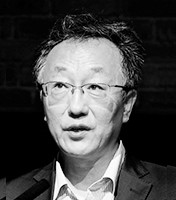
2016 Humanities and Social Sciences Laureate
Heon Ik Kwon
CV
- Studied Philosophy at Seoul National University
- B.A. in Political Science, University of Michigan, Ann Arbor
- M.Phil. in Social Anthropology, University of Cambridge
- Ph.D. in Social Anthropology, University of Cambridge
- Lecturer, University of Manchester
- Evans Fellow, University of Cambridge
- Lecturer & Reader, University of Edinburgh
- Reader, London School of Economics
- Member, National Academy of Arts
- Distinguished Professor, Trinity College, University of Cambridge
- Visiting Professor, Seoul National University
Reason for Award
Professor Kwon Heon-ik is an outstanding anthropologist whose research began with the study of the past of the Korean Peninsula’s division and the future of post-division, and has expanded to comparative studies on the process of de-socialization in Asia. He has published numerous highly regarded works in social sciences, including Cold War history, global contemporary history, diplomatic history, and war studies, as well as in area studies such as Asian and European studies.
His book After the Massacre (2006), based on field research in Vietnam, received the Clifford Geertz Award, one of the most prestigious awards in anthropology. Another of his works, Ghosts of War in Vietnam (2008), was awarded the George Kahin Prize by the Association for Asian Studies. In addition, Professor Kwon has consistently published numerous books and articles, including The Other Cold War (2010), which analyzes Asia’s post-socialist experience, and North Korea: Beyond Charismatic Politics (co-authored with Jeong Byung-ho, 2012), which provides an anthropological interpretation of the three-generation succession of the North Korean dictatorship.
Professor Kwon is recognized for his significant contributions to the global anthropological community through empirical fieldwork and innovative theoretical research. In particular, his historical-anthropological approach to the global Cold War has shed new light on Cold War history within a global context. His research demonstrates how concepts such as “cultural pluralism” and “cultural relativism” were formed and restructured as the international order shifted from a Europe-centered imperial system to a U.S.-Soviet-centered Cold War system.
Furthermore, his ongoing research on Asian societies and politics reexamines theoretical discussions in contemporary anthropology from the perspective of macro-history, making his future research contributions highly anticipated.
Acceptance Speech
First, I would like to thank everyone present here today, and especially Mr. Kyung Ahm Song Geum-jo, who made this event possible. After reading your autobiography, I was deeply impressed and thought, “Ah, this is what it means to turn a stony field into fertile land through hard work.”
As an anthropologist, I understand modern anthropology as a discipline that, much like Mr. Song’s journey, seeks to uncover the unique and shining ways of life in unfamiliar, rough places where few people venture or take notice. In the process of cultivating these places, one may, at a certain point, discover the universal aspects of humanity in the profoundly ordinary and be amazed by them. This, in itself, is a gem of a discipline within the modern social sciences. Meeting Mr. Kyung Ahm in person today, I feel a renewed sense of connection as someone who approaches life with a mindset similar to that of a pioneering settler. You wrote in your autobiography that you lived life as it came, and I, too, have lived that way.
The first unfamiliar place I explored was at the far eastern edge of the Siberian continent, home to nomadic hunter-gatherers. The agricultural and industrial cultures we are familiar with were unfamiliar there, and their political environment was also different from ours. At that time, the Soviet Empire still existed, and although its international socialist federation was disintegrating, it nominally persisted.
I encountered these two unfamiliar aspects simultaneously one day in December 1989. On that day, as before, the KGB officer assigned to me visited the nomadic camp where I was staying in an untracked vehicle. We shared warm tea inside the tent, but the atmosphere was unusual. Normally, he would have asked where I had been, whom I had met, or whether I had approached any military zones. That day, however, he sat in silence for a long while, smoking one cigarette after another, before suddenly asking me what I thought of the recent Berlin events. He sighed and asked what I thought the world would look like going forward.
After seeing him off, I fed the dogs and went late in the afternoon to check the nets I had set in a nearby stream. I retrieved the caught salmon and returned to camp, but as expected, the weather turned violently into a blizzard. My footprints disappeared, nearby trees all looked different, and I lost my way. After wandering exhausted for a long time, I must have collapsed. It was extremely cold. In my dream, I saw an old man with a white beard like a mountain spirit from childhood pictures; the beard brushed against my face. When I half-opened my eyes, a white-furred reindeer was sniffing my face with its nose and mouth. The reindeer’s name in the local language was “White Stone,” and later, when its leg was fractured and I had no choice but to catch and cook it, I felt deeply saddened.
Having survived without freezing, I have since reflected on the meaning of 1989. My initial curiosity was straightforward: how do people live on the other side of the Iron Curtain in socialist and communist societies? Over time, my questions expanded: why does the Iron Curtain collapse in some parts of the world but not in others? Why does the Cold War manifest peacefully in some areas and violently in others? In Busan, many people fled their hometowns during the Korean War. For separated families, the more tangible and visible barrier may be less relevant than the invisible but deeply real bonds among family and kin. I have thus approached the Cold War as a topic of comparative global history, while also understanding it not just as inter-state relations, but in terms of everyday human relations.
These are familiar topics for Koreans, but presenting them meaningfully within Cold War discourse, which is typically centered on European and Western experiences, is challenging. Furthermore, in modern social theory, which often focuses on the state and the individual, it is not easy to place family and community relations at the center and discuss the human condition of modern history in universal terms. Although there is a gap between theory and phenomenon, I have tried not to hastily critique specific phenomena with theoretical language. Instead, I have carefully examined the classical language of modern social theory, seeking a broader horizon beyond contemporary constraints.
I sometimes imagine that it might not have been only “White Stone” that helped me survive the blizzard of 1989. When I first crossed the Cold War barrier voluntarily, my mother, who had suffered greatly during the Korean War, was deeply worried. Her heart condition worsened, and she climbed mountains to pray to the spirits of the land. Perhaps her concern and actions were not unrelated to the curiosity that led me to notice the fallen reindeer.
Modern anthropology observes reality coldly and concretely but does not deny that there may be another reality beyond what is visible, because social reality is relational. And precisely because there is a reality beyond reality, we understand ourselves as social and ethical beings. This understanding brings freedom and ease.
I receive today’s Kyung Ahm Award not merely as praise for past achievements, but as encouragement to advance further, to think more freely and rigorously about the human condition. I thank the foundation and promise to continue engaging with the history of the world while grounded in this land, striving to understand the historical conditions we face with clarity and precision.