



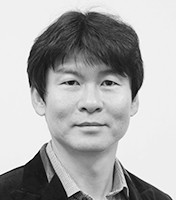
2016 Natural Sciences Laureate
Hyo Cherl Lee
CV
- B.S., Chemistry, KAIST, Magna Cum Laude
- Ph.D., California Institute of Technology (Caltech)
- Postdoctoral Fellow, Caltech
- Postdoctoral Scholar, University of Chicago
- Assistant Professor, Department of Chemistry, KAIST
- Associate Professor, Department of Chemistry, KAIST
- Professor, Department of Chemistry, KAIST
- Director, Center for Time-Resolved Diffraction, Creative Research Initiative Program
- Associate Director, Center for Nano-Materials & Chemical Reactions, Institute for Basic Science (IBS)
Reason for Award
Professor Hyo cherl Lee is an outstanding scientist who pioneered a world-first experimental technique that combines X-ray crystallography with ultrafast spectroscopy, enabling the observation of chemical reactions in three-dimensional space and on ultrafast timescales. Using this approach, he has achieved remarkable results by monitoring reaction pathways and transition states in solution, thereby establishing a new field known as solution-phase X-ray structural dynamics.
Professor Lee has also focused on reactions occurring within protein molecules, demonstrating that these reaction pathways can be controlled. This research is particularly noteworthy as it provides a foundation for understanding the signal transduction mechanisms of photoactive proteins. In addition, he has made significant contributions by elucidating in detail how the molecular structures of solutes present in small quantities in solution change depending on the properties of the solvent.
By pioneering these new research areas and advancing the frontiers of science, Professor Hyo cherl Lee is recognized globally as a leading figure in his field. In recognition of these achievements, he has been selected as the recipient of the 12th Kyung Ahm Science Award in the Natural Sciences category.
Acceptance Speech
I am deeply honored to receive this prestigious award. First, I would like to express my gratitude to Chairman Song Geum-jo, who founded the Kyung Ahm Education & Culture Foundation, and to Executive Director Jin Ae-eon. I also thank all the foundation staff, as well as those who recommended and selected me for this award. My sincere thanks go to everyone present today, celebrating and honoring this occasion with me.
It has been 15 years since I began my research career in Korea. At a time when I felt the need for new changes, receiving this meaningful award serves as a great encouragement to advance to the next level. I would also like to thank my academic advisors and colleagues who have supported me throughout my journey. Finally, though I was originally an atheist and a materialist who believed that everything could be explained by matter, my research has revealed the hand of the Creator in matter and space, and I can no longer deny the existence of God. I dedicate the honor I receive today to my Creator, God the Father, who has given meaning to my life.
From the perspective of a chemist, all matter in the world is composed of molecules. Some chemists strive to create more useful molecules, while others, like myself, wish to observe what happens when these molecules undergo chemical reactions. Observing molecular motion is challenging because molecules are extremely small and move extremely fast. To see something tiny, a microscope is required. However, no ordinary microscope can visualize molecules because the wavelength of visible light is much larger than the size of a molecule.
To observe molecules, light with a wavelength similar to the size of the molecules must be used—this is X-ray. X-rays are used in medical imaging, but conventional X-ray photography cannot capture molecules due to their tiny size. Instead, diffraction is employed. For example, while the surface of a DVD or CD appears smooth to the naked eye, it contains microscopic grooves that store large amounts of data. By shining a laser pointer on such a surface, diffraction occurs and multiple beams of light appear, with the spacing between beams determined by the groove spacing.
Applying the same principle to X-rays and molecules, the diffraction patterns allow us to determine molecular shapes. This technique enables the determination of protein three-dimensional structures, which provide critical information for drug development. However, observing changes in molecular shape during chemical reactions introduces another challenge: molecules move too fast. Capturing such rapid motion requires ultrafast “shutter” speeds. By combining X-ray diffraction with extremely short X-ray pulses, the time-dependent diffraction patterns can be analyzed to measure structural changes over time. This method is called time-resolved X-ray diffraction.
Before I returned to Korea in 2003 to begin my research, this technique could only be applied to crystalline, solid-state samples. For example, to determine a protein’s structure, one needed to grow protein crystals and analyze the resulting diffraction patterns, much like the structured surface of a DVD. Even textbooks at the time noted that resolving the detailed structure of multi-atomic molecules in solution was nearly impossible. However, one lesson I learned during my Ph.D. was not to blindly accept what others claim is impossible. The textbooks were based on outdated knowledge, and the situation had changed in the 2000s. I therefore attempted time-resolved X-ray diffraction experiments on molecules dissolved in solution, successfully identifying the structures of various reaction intermediates generated by light-induced reactions.
The next stage of my research focused on larger molecules—proteins in solution—despite skepticism at the time. Ultimately, we demonstrated that these studies were feasible. Looking ahead, my goal is to measure molecular structures in reaction transition states, which were previously considered directly unobservable. A recent study published in Nature represents a small first step toward this objective. I believe that receiving this award today will further empower my efforts to achieve this goal.
Finally, I wish to thank those who have supported me along the way, both nearby and behind the scenes: my life partner and closest friend, my parents, and my family and relatives. The research would not have been possible without my students, research staff, and collaborators who stayed up all night collecting data. I also extend my gratitude to my academic mentors and colleagues. As I mentioned, though I was originally an atheist and materialist, my research has revealed the Creator’s hand in matter and space. I dedicate the honor of this award to God the Father, the Creator, who gives purpose to my life. Thank you.