



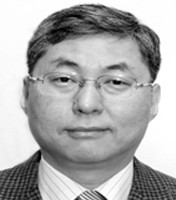
2014 Engineering Laureate
Hoi Jun Yoo
CV
- B.S., Electrical Engineering, Seoul National University
- M.S., Semiconductor Engineering, Korea Advanced Institute of Science and Technology (KAIST)
- Ph.D., Semiconductor Engineering, Korea Advanced Institute of Science and Technology (KAIST)
- Researcher, Bell Communications Research, USA
- DRAM Design Director, Hyundai Electronics Semiconductor Research Center
- Professor, Department of Electrical Engineering, KAIST
- Project Manager, Ministry of Information and Communication, Korea
- IEEE Fellow
- TPC Chair, IEEE Asian Solid-State Circuits Conference (A-SSCC)
- President, Korean Society for Next-Generation Computing
- TPC Chair, IEEE International Symposium on Wearable Computers (ISWC)
- TPC Chair, IEEE International Solid-State Circuits Conference (ISSCC)
Reason for Award
Professor Hoi Jun Yoo is a world-class researcher in the field of semiconductor chip design, playing a central role in elevating Korea’s semiconductor technology and industry to a global level. In particular, he has conducted research in the field of wearable systems (Wearable Device), which is considered a culmination of modern engineering, exemplified by human-body communication, fabric-type printed circuit boards, and the development of K-Glass, a counterpart to Google Glass. As a leading scholar in this field, he has led world-class research through publications in internationally renowned journals and active participation in academic societies.
Professor Yoo designed the ultra-low-power, high-performance processor, a core component of wearable devices. This newly devised "brain-inspired processor," which combines neuroscience, cognitive science, and semiconductors, enables high-performance multi-image recognition processing for wearable devices using visual information. The K-Glass developed by Professor Yoo using this processor, unlike the existing Google Glass, is equipped with a dedicated brain-inspired processor, and was presented at ICSSCC in February 2014, receiving enthusiastic responses.
Meanwhile, the industrialization of wearable systems, Professor Yoo’s recent research field, is still at an early stage and is assessed as a field with very high growth potential. Thus, his ongoing activities and contributions in this area are highly anticipated. Considering Professor Yoo’s academic achievements, contributions to industry, and future growth potential, he is deemed fully qualified for the Kyung Ahm Award in the engineering category.
Acceptance Speech
I worked as the design manager for 1M DRAM to 256M DRAM at what is now Hynix, formerly Hyundai Electronics, and in 1994, I moved to a university position. After joining the university, I began to consider the direction and focus of my research. I realized that continuing large-scale Memory design research, which requires substantial manpower and funding, would be challenging in an academic setting. I thought it would be better to conduct applied research based on memory technology. By utilizing Korea’s strong memory capabilities for research, I could provide new opportunities for Korea’s memory industry and help pioneer its future. Additionally, I wanted to make semiconductor research more approachable to young people by creating chips that move, make sounds, and are visually observable, rather than remaining invisible and complex.
From this perspective, I focused on three areas: computer games, intelligent robots, and wearable computers. I began researching chips for computer games, and in 1999, before games were fully introduced into mobile phones and smartphones, I developed the world’s first mobile game chip and presented it at the ISSCC conference. In 2001, I held an intelligent robot competition and conducted robot research, which became a precursor to my recent research on “brain-inspired intelligent processors,” a field actively pursued in advanced countries.
Once again, I would like to express my gratitude to everyone who trusted and supported me to reach this point: my late father, my father-in-law, my mother and mother-in-law who always pray for me, the late Professor Kwon Young-Se, my former students and current students who have devoted themselves to research tirelessly, and my wife. Thank you all.
In 2006, I conceived the idea of directly printing electronic circuits onto ordinary fabric. After consulting with my mentor, Professor Kwon Young-Se at KAIST, he graciously allowed us to use the circuit board research facilities. Through experimentation, we confirmed that circuits printed on fabric exhibited characteristics almost identical to conventional plastic-based electronic circuit boards. We named this technology P-FCB (Planar Fashionable Circuit Board) and developed a method to directly bond semiconductor chips onto these fabric boards. Based on these technologies, in 2008, we presented the world’s first garment-type wearable computer at the ISSCC conference, integrating the three essential computer components—input device, CPU, and output device—onto an ordinary shirt. As a result, Korea transformed from a peripheral country in wearable computer research into a world-leading research hub, receiving collaborative research proposals from MIT in the United States and IMEC in Europe.
Previously, wearable computers were limited to setups where electronic components were disassembled, placed in pockets, and connected with wires, or where conductive fibers were sewn into garments. However, our research team directly printed circuits on clothing and bonded semiconductor chips, achieving superior comfort, lightweight design, and ease of use, thereby pioneering a new approach in wearable computer research. Most importantly, the disposable use of semiconductors in this way could significantly expand the market for Korea’s semiconductor industry.
The technology has broad applications and can serve as a fundamental technology for next-generation wearable computers such as watches and glasses. Because it uses fabric that does not interfere with the body, it is also highly useful for wearable electronic devices like patches. Using this approach, we developed cost-effective and user-friendly devices such as patch-type wireless ECG monitors, sleep disorder diagnostic devices, intelligent traditional acupuncture systems, smart drug delivery devices, and headband-style mental health monitors. We named this field “Wearable Healthcare” and have continued diverse research to establish it as a new engineering discipline.
In my other research field, intelligent semiconductors, we developed brain-inspired processor architectures and recently created the world’s first low-power augmented reality processor for glasses-type computers. Using this processor, we developed K-Glass, a glasses-type computer that is faster and more power-efficient than Google Glass. Since 2006, we have also researched body communication technology, which uses the human body as a communication medium. This method is not only low-power but also achieves significantly higher transmission speeds, making it highly valuable. Based on our research, these technologies were adopted as international standards in 2012. Using this technology, our team created K-Watch, a wrist-worn body signal measurement and transceiver device, which was presented at the ISSCC conference in the United States. Consequently, we have led research across all categories of wearable computers, including K-Watch, K-Glass, patch-type wearables, and garment-type devices.
In summary, my research focuses on semiconductors that are human-centered and widely beneficial to humanity—semiconductors that make people happy. Guided by the three core values of human happiness—health, creativity, and sociality—I have pursued research in “Wearable Healthcare for health,” “brain-inspired intelligent semiconductors for creativity,” and “body communication technology for sociality,” continuously conducting these studies with KAIST students.
When I first heard about the Kyung Ahm Science and Engineering Award, I was unsure if I could ever receive it, as I have rarely been associated with such major awards. When I finally received the notification of the award, I felt a mix of emotions and joy in being recognized for my years of dedicated work. However, I soon realized that this award is not simply a recognition of past achievements, but a call to start anew, to abandon previous accomplishments, and to pursue new dreams. It is a reminder that I still have far to go and must continue striving toward higher goals.
Throughout my life, I have believed in constantly starting anew and viewing things from fresh perspectives, and I have encouraged the same approach among my students. Conducting forward-looking research in Korea is not an easy task, as limited understanding of potential and fear of failure often hinder continuous support, and I am not entirely free from these challenges, such as research funding issues. Nevertheless, I believe that if one pursues research with the devotion of a true seeker, leaving nothing behind, one will have no regrets. I will continue my research with this conviction and gratefully accept the Kyung Ahm Award as encouragement for both my life and work.
Finally, I would like to once again express my deepest gratitude to everyone who has trusted and supported me to reach this point: my late father, my father-in-law, my mother and mother-in-law who always pray for me, the late Professor Kwon Young-Se, my former students and current students who have tirelessly devoted themselves to research, and my wife. Thank you all.