



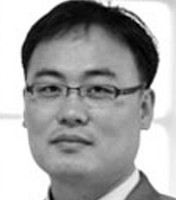
2011 Natural Sciences Laureate
Byung Hee Hong
CV
- B.S., Pohang University of Science and Technology (POSTECH), Korea
- M.S., Pohang University of Science and Technology (POSTECH), Korea
- Ph.D., Pohang University of Science and Technology (POSTECH), Korea
- Postdoctoral Researcher, Pohang University of Science and Technology (POSTECH), Korea
- Postdoctoral Researcher, Columbia University, USA
- Assistant Professor, Sungkyunkwan University, Korea
- Associate Professor, Seoul National University, Korea (current)
Reason for Award
Graphene was first synthesized in 2004 by Geim and Novoselov, and it was recognized as a material with a novel two-dimensional electronic structure. After receiving his Ph.D. from Pohang University of Science and Technology (POSTECH), Professor Byunghee Hong began his research on graphene as a postdoctoral researcher at Columbia University in the United States.
Upon returning to Korea, he discovered that chemical vapor synthesis of graphene was possible and successfully realized it experimentally. This experimental discovery was an important milestone that opened a new chapter in graphene research. Not content with this achievement, Professor Hong further published a method for synthesizing large-area graphene.
Recently, following the synthesis of wafer-scale graphene, he proposed a method to synthesize 30-inch graphene transparent electrodes using a roll-to-roll process that is industrially scalable, drawing significant attention from the academic community. This achievement is recognized as a landmark result that elevates laboratory graphene research to a level suitable for industrial applications.
Professor Byunghee Hong is a young scientist who obtained his B.S., M.S., and Ph.D. in Korea and conducted significant research domestically. His research results, carried out in Korea by a young scientist, have been recognized worldwide as establishing a new paradigm in the scientific community, which was also a factor in his selection as an award recipient.
Acceptance Speech
Honorable Chairman Song Geumjo of the Kyung Ahm Foundation, Chairman Lee Jang-moo of the Judging Committee, former Prime Minister Lee Hyun-jae, and distinguished guests,
Today, I would like to share my acceptance speech under the theme of "Encounters." Life is a series of encounters, and those encounters have led me to this very moment.
The first encounter is one I could not choose—my parents. My father, in particular, was a businessman ahead of his time. Thirty years ago, when people paid little attention to environmental issues, he ventured into green industries aimed at reducing harmful gases, facing failures along the way. Repeated challenges and setbacks brought financial hardships, yet he passed down an unwavering spirit of challenge to me.
The second encounter is with my beloved wife, whom I chose. Since marrying during my graduate school years, my wife has always been my partner and steadfast supporter. Even during the time I worked as a researcher in the United States, when my bank account once had only ten dollars, I was able to endure those difficult times because of her constant trust and encouragement.
The third encounter is with my beloved children. My eldest, Yerin, has already changed schools five times, and recently had to transfer once again as I moved institutions. I want to express my deep gratitude to Yerin for growing up beautifully and healthily despite challenging circumstances. My youngest, Harin, born not long ago, cannot be left out. Her original due date coincided with this awards ceremony, but she came two weeks early, allowing my wife to recover and attend today.
The fourth encounter is with my advisors. My Ph.D. advisor was Professor Kwangsoo Kim of POSTECH, a national scientist. His passion for research was unmatched, and he instilled confidence in his students that they could compete with world-class universities. I first encountered the material graphene through Professor Philip Kim at Columbia University, who narrowly missed winning the Nobel Prize last year. Through him, I experienced what world-class research truly entails.
The fifth encounter is with all of you here today.
I would like to humbly say that I will always remember and follow the noble intentions of Kyung Ahm Song Geumjo and strive toward even greater dreams. I ask for your support so that, ten or twenty years from now, when I am recognized further as a scholar and receive international awards, I may proudly say that I am a recipient of the Kyung Ahm Academic Award. I will treasure and nurture the encounter with all of you who bear witness to this moment.
Finally, I give the greatest thanks to God, who orchestrated all these encounters, and express my gratitude to all of you for listening to my humble acceptance speech.