



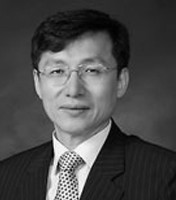
2009 Life Sciences Laureate
Tae Won Noh
CV
B.S., Department of Physics and Astronomy, Seoul National University, Korea
M.S., Department of Physics, Ohio State University, USA
Ph.D., Department of Physics, Ohio State University, USA
Assistant Professor, Associate Professor, Professor, Department of Physics and Astronomy, Seoul National University, Korea
Director, Oxide Electronics Research Center, Seoul National University, Korea
Foreign Research Fellow, University of Tokyo, Japan
Full Member, Korean Academy of Science and Technology
Vice President, Korean Physical Society
Editorial Advisory Member, Materials Today
Reason for Award
Professor Tae-Won Noh is a leading scholar in the field of condensed matter physics, specifically in “oxide electronics.” He has discovered new physical properties in transition metal oxides (also referred to as "ceramics") and has physically elucidated the fundamental limiting characteristics that may appear in device applications based on the basic mechanisms of these properties.
Building on these research achievements, Professor Noh has contributed significantly not only to the development of the new academic field of oxide electronics but also to the advancement of condensed matter physics in Korea. Among these accomplishments, his most representative achievement is the study of the physical properties of ferroelectric thin films. In 1999, Professor Noh creatively addressed the reliability issues of ferroelectric thin films and proposed a new theory on fatigue phenomena. Based on this theory, he developed thin films as new materials for FeRAM and published his findings in Nature. This paper had a significant impact on materials scientists studying memory both domestically and internationally, as well as on industry.
Professor Noh’s achievements are particularly noteworthy considering the challenging research environment in Korea at the time. He was the first to develop experimental methods such as PLD and laser MBE domestically, and he entered research areas such as ferroelectric thin films and manganese oxides, which had received little international attention at the time, achieving world-class results.
His research highlights the importance of fundamental scientific studies based on creative ideas. While most researchers approached their work through trial-and-error methods, Professor Noh developed a model based on oxygen stability for FeRAM research and creatively proposed a new percolation model for ReRAM research, elucidating its operational principles and limitations. In this way, he has provided a foundation for new fundamental science and has made a substantial contribution to the advancement of related fields.
To date, Professor Noh has delivered 78 keynote and invited talks at international conferences, and in 2008, he was selected as a Fellow of the American Physical Society. He serves as the organizing chair of three international conferences, including the International Workshop on Oxide Electronics (WOE-14), and has participated as an organizing and program committee member for 25 international conferences. Additionally, he is an editorial advisory board member of Materials Today, which has a high citation index of 12.929, and serves as the editor-in-chief of Current Applied Physics, published by the Korean Physical Society.
Acceptance Speech
Thank you. Receiving the Kyung Ahm Academic Award this time is both overwhelming and a great honor for me. Although there are many senior and junior scholars around me who are far more accomplished than I am, I feel humbled to be the first among them to receive this award.
Twenty years ago, in 1989, I returned from studying in the United States and joined the Department of Physics at Seoul National University. At that time, investment in basic science in our country was very limited. As someone who majored in solid-state spectroscopy in the United States, I found it difficult to start research due to a lack of funds and opportunities to purchase expensive equipment. At that time, Professor Kwon Suk-il suggested that I consider conducting research on ferroelectric oxide thin films. Following his recommendation, I entered the field of ferroelectrics, running around Cheonggyecheon and Guro Industrial Complex with my students, purchasing and assembling components, and enduring many hardships together. Moreover, I devoted all my energy to finding creative and novel research ideas and pursuing them tirelessly, day and night. Because I enjoyed these moments with my students, I believe I have now reached the honored position of being a Kyung Ahm Academic Award recipient.
Many people have contributed to my success as a researcher. First, although they could not attend this ceremony due to health reasons, I would like to thank my parents who gave me life, raised me, respected my talents, and always supported me both materially and emotionally. Next, I would like to express my gratitude and love to my wife and children, who showed patience and encouragement despite my spending most of the day at the university as a husband and father. I would also like to thank my mentors in the Department of Physics at Seoul National University, who taught me the joy of being a scientist, as well as many domestic and international colleagues who participated in generating new ideas. In particular, I would like to thank Professors Yoon Jong-gul of Suwon University, Jung Jin-seok of Soongsil University, Song Tae-kwon of Changwon University, and other professors who came to my laboratory every Saturday over the past ten years, even on holidays, to help guide the students.
Lastly, I would like to dedicate the credit for this award to the numerous students and postdoctoral researchers who have passed through my laboratory. I especially want to express my gratitude to Professors Ahn Jae-seok of Pusan National University, Kim Myung-hoon of Jeonbuk National University, Lee Yoon-sang of Soongsil University, Kang Bo-su of Hanyang University, and my current students, who made time to attend despite their busy schedules. Without the sweat and effort of such outstanding students, I would never have been able to stand in this place.
I have long cherished a dream. Among the students I have taught, many have become far better scholars than I am, and my dream is for one of these students to grow into a world-class scholar capable of winning a Nobel Prize. Taking this Kyung Ahm Academic Award as an opportunity, I will devote all my energy to nurturing excellent talents so that my dream can surely be realized in the future. Thank you.