



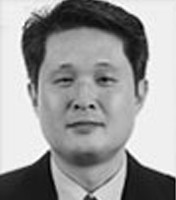
2008 Life Sciences Laureate
Jeong Han Kim
CV
- B.S. in Physics, Yonsei University
- M.S. in Mathematics, Yonsei University
- Ph.D., Rutgers University, New Jersey, USA
- Senior Researcher, AT&T Bell Laboratories
- Principal Researcher, Microsoft Research
- Professor, Department of Mathematics, Yonsei University
- Professor, School of Computational Sciences, Korea Institute for Advanced Study (KIAS)
Reason for Award
Jeong Han Kim is a world-renowned researcher who studies discrete mathematics (combinatorics and computational mathematics), which forms the theoretical foundation of computer software. Through solving open problems in graph theory and proposing new models, he has made a profound academic impact not only in the field of mathematics but also across the entire scientific community.
Among his other global achievements, during the nascent period of computer science, he created the best-known algorithm for the sorting problem (1995), surprising the world. Recently, he devised a new model in random graph theory, which is a mathematical model of Internet web pages. This new random graph model provides a breakthrough for creating and understanding a mathematical model of the Internet, which can be considered a core of 21st-century information science.
Before returning to Korea in 2006, he worked at AT&T Bell Laboratories and the Princeton Institute for Advanced Study. From 1997 until the summer of 2006, he served as a founding member and senior researcher of the Theory Group at Microsoft Research Headquarters, playing a central role in research on combinatorics and algorithm theory.
In 2006, Jeong Han Kim had the honor of delivering an invited lecture at the International Congress of Mathematicians (ICM), often referred to as the "Mathematics Olympics," becoming the first Korean to do so. In 2007, he received the Science and Technology Award for Role Model and was appointed as the Underwood Chair Professor at Yonsei University. In addition, he became the first mathematician selected for the Creative Research Initiative Program supported by the Korea Science Foundation, and he serves as an editorial board member for Random Structures and Algorithms, a top journal in the field. His scholarly activities continue to be highly active and prestigious both domestically and internationally.
He returned to Korea at the peak of his academic career, foregoing substantial benefits and treatment available only in the United States. He has devoted himself to research and education, establishing Korea’s top research group and nurturing outstanding successors, serving as a model for the academic community. The academic community is confident that he will achieve further scholarly accomplishments that surpass his existing achievements and make even greater contributions to the development of mathematics and the natural sciences in Korea.
Acceptance Speech
I would like to express my gratitude to Chairman Geum-Jo Song, former Deputy Prime Minister An Byung-Young, KAIST President Nam-Pyo Suh, and former President of the Korean Academy of Science and Technology Tae-Gil Kim. Despite your busy schedules, you came here to honor this occasion, and I sincerely thank you for that.
Although I have many areas to improve, I will continue my research with great effort and strive to become a researcher who brings honor to the Kyung Ahm Award. I am deeply grateful to all of you who have given me this award.
The first value I emphasize is professionalism. I have always strived to enhance my own value and constantly monitor my market variables while conducting research. I aim to be a researcher whose work benefits others and contributes to mathematics for the advancement of science and the nation.
The second important point is my genuine love for mathematics. I will always make sure that the answer to the question, “Do I really love mathematics?” can always be “yes.”
Looking back on my life, many of my actions have been motivated simply by fear or love. However, when it comes to mathematics, I have tried not to act out of fear or desire but out of love for the subject. I believe this approach has led to these good results.
Finally, I intend to use this valuable prize money to contribute to the International Congress of Mathematicians (ICM), which our mathematics community refers to as the 2014 Mathematics Olympics. Famous soccer players always say upon returning from overseas that youth soccer is important. Likewise, I realized after returning from overseas that youth mathematics is crucial. It is essential to provide children with the opportunity to think critically and engage in logical reasoning rather than rote memorization. I hope to use this prize to promote and support youth mathematics.
Although I have many areas to improve, I will continue my research with great effort and strive to become a researcher who brings honor to the Kyung Ahm Award. I am deeply grateful to all of you who have given me this award.