



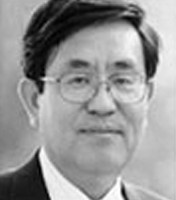
2008 Engineering Laureate
Bum man Kim
CV
- B.S., College of Engineering, Seoul National University
- M.S., University of Texas at Austin
- Ph.D., Carnegie Mellon University
- Research Scientist, GTE Labs.
- Senior Research Scientist, Texas Instruments Inc.
- Professor, Department of Electrical Engineering, Pohang University of Science and Technology
Reason for Award
Bum Man Kim is a globally recognized scholar in the fields of Microwave Monolithic Integrated Circuits (MMIC) and Power Amplifiers for mobile communications. In particular, Professor Kim has made significant research contributions in the field of MMIC using Gallium Arsenide (GaAs). The high-speed integrated circuit (IC) technologies developed in this area have been widely used in U.S. defense-related weaponry and are currently applied in the development of RF circuit technologies for mobile communications.
As a result of these achievements, Professor Kim was selected as a distinguished lecturer by the IEEE MTT Society (IEEE Microwave Theory and Techniques Society) and was invited to give expert lectures at conferences and MTT Society events worldwide between 2005 and 2007, gaining international recognition. Currently, Professor Kim is a Fellow of both IEEE (USA) and IET (UK), a member of the AdCom operating the IEEE MTT Society, the leading organization in the field of microwaves centered in the United States, and the only Asian representative of the General Assembly, which is the governing body of the Microwave Association based in Europe.
Professor Kim has also made outstanding achievements in the emerging field of RFICs for mobile communications, which use similar technologies. In particular, the new linear amplifier he developed, known as the Doherty Amplifier, is currently used in mobile communication base stations and relay equipment worldwide. This amplifier creates a market exceeding 10 trillion KRW annually. It is expected that the Doherty Amplifier will be widely applied to power amplifiers of other devices requiring linear amplification, such as WCDMA (Wideband Code Division Multiple Access) terminals.
Furthermore, Professor Kim expanded the maximum gain frequency of InP HBTs (Indium Phosphide Heterojunction Bipolar Transistors) to the 700 GHz band, realizing the fastest semiconductor devices, and he was the first to implement fully integrated CMOS (Complementary Metal-Oxide-Semiconductor) linear power amplifiers, achieving excellent research outcomes in the development of various linear power amplifiers.
Acceptance Speech
Upon receiving the news that I have been awarded the Kyung Ahm Academic Award, I revisited the significance of this honor. I deeply respect the words of the founder, who established the Kyung Ahm Academic Foundation to contribute and dedicate oneself to society, acknowledging that a life solely pursuing material wealth, work, and achievements cannot satisfy the soul.
He also set the goal of contributing to the advancement of education and culture. Such progress has depended not only on the collective efforts of all members of society but also greatly on the abilities of a few outstanding individuals. By honoring these individuals and motivating them to dedicate themselves to the study of classical Chinese, the foundation seeks to enhance the quality of human resources and cultivate an elevated culture. I consider it a profound honor to be evaluated in this esteemed company, and I feel the weighty responsibility it entails. I also regard this as an encouragement to lead well in the future and will continue my efforts accordingly. Much of this has been possible thanks to the efforts of our group’s students and the support of various interested institutions.
Human thought is developed through training and education, and excellent achievements are produced through continuous effort. I believe that such personal efforts become possible when combined within an environment that fosters this atmosphere. Since the 1990s, research culture in our country has begun to take shape, and I think it has developed significantly over time. Nowadays, good research results are also being generated domestically. However, there is still much to grow and develop, as our experience is relatively short.
To promote this development, I reaffirm through this opportunity my commitment to devote my utmost efforts not only to producing personal achievements but also to cultivating an excellent domestic research environment and nurturing outstanding future talents. Thank you.