



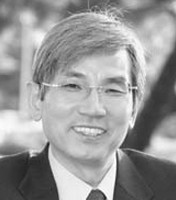
2007 Engineering Laureate
Heun Lee
CV
B.S. in Chemical Engineering, College of Engineering, Seoul National University
M.S., University of Southern California
Ph.D., Northwestern University
Senior Researcher, Korea Institute of Science and Technology (KIST)
Visiting Professor, University of California, Berkeley
Professor, Department of Bio and Chemical Engineering, KAIST
Acceptance Speech
Heun Lee first proposed the core concepts and technologies for developing gas hydrates and hydrogen energy, which have emerged as the two main pillars of future energy and have become a global focus of interest. Recently, he developed a fundamental production technology that allows natural gas to be stably recovered by exchanging subsea gas hydrates with carbon dioxide, which has attracted worldwide attention (Proc. Nat. Acad. Sci., USA 2006. 8).
The amount of gas hydrate deposits worldwide is more than twice that of currently used fossil fuels such as coal and oil, and it has been confirmed that approximately 600 million tons (USD 150 billion) are present beneath the East Sea of Korea. In particular, this exchange technology is expected to become the only option applicable for gas hydrate production in countries around the world in the future, and it is anticipated to make a significant contribution to securing next-generation energy resources for Korea. Heun Lee has obtained domestic patents (recently, the Korean Intellectual Property Office specially reported to the media on the importance of the exchange technology and the patent acquisition) and has also filed patent applications in the United States, Japan, and other countries.
Heun Lee also demonstrated, through microscopic and macroscopic experiments, that hydrogen molecules can be stored at subzero temperatures in numerous nanoscale voids created within ice particles, and this finding was selected as a Highlight paper in Nature on April 7, 2005. This achievement has laid a groundbreaking foundation for accelerating the era of future hydrogen energy. By revealing the mechanism for directly storing hydrogen in ice particles, composed of water, the most ubiquitous and abundant substance on Earth, he is expected to make a significant contribution to the establishment of future fuel cells and a hydrogen economy, which are projected to form the basis of future industries.
Furthermore, ice, unlike other materials, exhibits unique and remarkable properties, showing the potential for use as a new material in various industrial applications such as hydrogen storage. Moreover, Heun Lee pioneered a new scientific and technological field, known as ice science and engineering.
Heun Lee has published 131 international papers and 42 domestic papers, and holds 5 international patents and 12 domestic patents. He has contributed extensively to internationally renowned journals, including Science and Nature. He has also been selected for multiple honors, including the Scientist of the Month Award (September 2005, Korea Science Foundation), the Seok-Myeong Outstanding Chemical Engineer Award (2006, Korean Institute of Chemical Engineers), the recognition as a Korean scientist highlighted by the world’s three major science journals (2006, Korea Science Foundation), and the KAIST Academic Award (2007, KAIST). In addition, Heun Lee has served as an invited and keynote speaker at prestigious international conferences such as MRS.
Acceptance Speech
Personally, this is an extremely joyful day for me, and I feel truly honored.
Finally, I would like to express my deep gratitude to all the staff who have worked tirelessly behind the scenes to make today’s wonderful event possible, ensuring both the beautiful scenery and the excellent venue. Thank you very much.
Regarding my research so far, I have been working on future energy, hydrogen, and recently, on gas hydrate production technology, which has emerged as a focus in the field of future energy. However, even now, the level of my achievements is still quite modest. It is not an easy field to lead and make breakthroughs on a global scale. Nevertheless, I am currently doing my best, and most of the support I have received has been through national research funding. Therefore, the taxes contributed by our parents and siblings have enabled me to conduct research. I have about eight to nine years left before retirement, and during that time, I will do my utmost to contribute, even just a little, to addressing the current challenging energy situation. I will leave the results to fate after human effort.
I would like to give special thanks to Chairman Geum-Jo Song, who has created the precious and valuable Kyung Ahm Foundation and awarded this prize, allowing such a great purpose to be realized today. I respect you greatly. I also acknowledge that I am still lacking and that my achievements are modest, so I sincerely thank the selection committee for kindly recognizing my work and granting me this award.
Finally, I would like to once again sincerely thank all the staff who have worked tirelessly behind the scenes to make today’s wonderful event possible, ensuring both the beautiful scenery and the excellent venue. Thank you very much.