



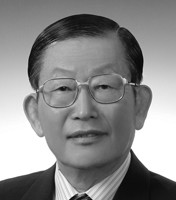
2006 Humanities and Social Sciences Laureate
The late Young Ick Lew
CV
B.A. in Political Science, Seoul National University
Ph.D. in History and East Asian Languages, Harvard University
Professor, Department of History, Korea University
President, Korean Historical Association
Vice President & Dean of Graduate School, Hallym University
Distinguished Professor, Graduate School of International Studies, Yonsei University
- Chairperson, National Institute of Korean History
Reason for Award
Professor Young Ick Lew has freely crossed the boundaries of domestic and international academia, building outstanding scholarly achievements and making significant contributions to the internationalization of Korean studies. He is a pioneer in the field of modern and contemporary Korean history and is known as an “eternal active scholar.”
In particular, his research on important events and figures in modern and contemporary Korean history—such as the Gabo Reform, the Donghak Movement, and Syngman Rhee—represents accomplishments achieved through rigorous source verification. These works are evaluated as original and profound contributions that transcend existing theories and conventional ideas.
Since 1990, Professor Lew established the Institute of Modern Korean Studies at Yonsei University, hosting annual international symposia on major issues in Korean contemporary history and publishing the results as monographs. This has made a remarkable contribution to the internationalization of Korean studies.
The historical academic community has recognized his achievements, awarding him the 13th Sungkok Academic and Cultural Award in the Humanities and Social Sciences category in 1998. In 2000, the Institute of Modern Korean Studies at Yonsei University, led by him, became the recipient of the 3rd Ministry of Culture Award.
As a pioneer in the field of modern and contemporary Korean history, and above all as a tireless active scholar, he continues to produce an uninterrupted stream of works, opening new horizons in Korean modern and contemporary history and widely disseminating them to academic communities both in Korea and abroad. His vigorous scholarly and educational activities are highly esteemed.
Acceptance Speech
As you all know, everyone gathered here today at Nurimaru, the Kyung Ahm Academic Award is the most prestigious academic prize in Korea, awarded to individuals who have made significant contributions to our society and to the progress of humankind. It is therefore with the utmost honor that I accept the 2nd Kyung Ahm Academic Award in the Humanities and Social Sciences category.
I was originally born with modest abilities. That someone like me could receive the highly esteemed Kyung Ahm Academic Award is due, on one hand, to the grace of Almighty God, and on the other hand, to the nurturing and guidance of my parents and teachers, as well as the love and encouragement of countless relatives. I take this opportunity first to thank God, and then my siblings, family, and numerous senior and junior colleagues.
During my more than ten years at Yonsei University, my successful research on Syngman Rhee was made possible not only by the moral support of those around me, but also by several institutional conditions. In 1997, the Institute of Modern Korean Studies at the Yonsei University Graduate School of International Studies, supported financially by Samsung Group, consistently backed my research activities. I wish to express my gratitude to both current and former staff and executives of the Institute.
My research on Syngman Rhee was possible because Dr. In-Soo Lee, who is the adopted son of President Rhee and is present here today, entrusted me with Rhee’s documents that had been stored at Ewha Mansion, allowing me to make full use of them. Additionally, Mrs. Song-Ok Choi, present here, generously donated her high-end residence to Yonsei University for Rhee research, permitting me to use the space freely. I extend my sincere thanks to Dr. Lee and his wife, and to Mrs. Choi.
There is one person who devotedly supported me to reach the position I now hold as a historian in Korea: my wife. She, who reveres God more than anyone, has always valued scholarship over worldly wealth and fame, ensuring that I remained steadfast on the narrow path of academic pursuit. Tragically, she fell ill with a serious disease six months ago and is currently bedridden. She has been a victim of my excessive passion for research. Today, I intend to allocate the award funds primarily for her medical and care expenses, as a minimal act of atonement and gratitude.
I also wish to wish good health and happiness to Chairman Geum-Jo Song and his spouse, to the distinguished scientists and poet receiving awards with me today, and to all the guests present. Thank you.
The judging committee for my achievements included former Deputy Prime Minister of Education and Human Resources An Byung-Young, Chair of the Humanities and Social Sciences Committee Lee In-Ho, former Ambassador to Russia and President of the International Exchange Foundation, and committee members Professor Emeritus Kim Woo-Chang (Korea University), Professor Kim In-Jun (Seoul National University), Professor Lim Hyun-Jin (Seoul National University), and Professor Eom Jung-Sik (Sogang University). These are the finest intellectuals in Korea, combining profound scholarship with remarkable character. In my view, they are fully qualified to be Nobel Prize judges. For this reason, I regard receiving this award as equally honorable as receiving a Nobel Prize.
When I learned from Chairman An that I had been selected as the Humanities and Social Sciences recipient of the Kyung Ahm Academic Award, I questioned whether I truly deserved this prestigious honor. There are many scholars around me who are more capable and accomplished than I am. I am not a “star professor” frequently writing columns in newspapers or appearing on television.
I have also never suffered persecution for fighting for democracy or social justice. Moreover, I have reached the age where, in the past, one would retire from all scholarly activity. Yet, despite this, the Kyung Ahm Academic Award committee selected me as the recipient. Why might this be so? I have reflected on this question as follows:
First, I chose to specialize in Korean history, particularly modern and contemporary Korean history, a field that talented students often claim is important but actually avoid. After completing my undergraduate degree and military service in Korea, I went to the United States to pursue Korean history in earnest. Beginning my research in my late twenties, I found it deeply fascinating and important. For over 40 years, I have studied diligently, much like a high school senior preparing for college entrance exams. In short, I have devoted nearly my entire life to a single steadfast pursuit. I believe the Kyung Ahm Academic Award recognizes my long-term, disciplined, and ascetic academic effort, and I am deeply grateful to the committee for this acknowledgment.
Second, having studied political science in Korea and then pursuing East Asian history and Korean history in the United States, I possess a historical perspective that distinguishes me from most historians trained solely in Korea. Furthermore, having developed modern and contemporary Korean history almost independently abroad, I am not constrained by domestic academic factions or schools of thought. This relative freedom has allowed me to maintain a critically comparative attitude toward scholarly output in Korea. Some of my publications on modern and contemporary Korean history challenged established domestic theories, which occasionally resulted in my views being regarded as unorthodox. By awarding me the Kyung Ahm Academic Award, the committee has endorsed my critical perspective, and I am sincerely grateful for this support.
Third, in researching Korea’s modern and contemporary history, I determined that studying Syngman Rhee, a founding figure of the Republic of Korea, was urgent and essential. For more than ten years, I have devoted myself to Rhee research. During this time, I organized, compiled, and published documents originally held at Ewha Mansion and authored or edited multiple works regarding Dr. Rhee. This laid the foundation for objective research on Korea’s first president and provided a more balanced perspective, countering the previously one-sided critical view of Rhee. I am grateful that the Kyung Ahm Academic Award committee recognized the value of this decade-long project.
Syngman Rhee has become a lifelong research focus for me, and I continue to study him daily. My conclusion after extensive study is that Rhee was an extraordinary genius in history and that the Republic of Korea is the masterpiece of this genius. This view contradicts the common perception among many Korean intellectuals that Rhee was a corrupt and incompetent dictator and that Korea was a wrongly established country. I intend to devote myself to demonstrating that such perceptions are mistaken and proving that my view is correct. My dedication to studying and promoting Syngman Rhee stems from the fact that evaluating him and the founding of Korea is directly connected to our national pride and identity. As long as Rhee is denounced as a dictator and Korea as an ill-conceived nation, genuine patriotism is impossible. Conversely, recognizing Rhee as a divinely gifted genius and Korea as a model nation born through his efforts allows us to take immense pride in our country. By this measure, the Rhee research I have undertaken holds practical value far exceeding, by hundreds or even millions of times, the monetary award provided by the Kyung Ahm Foundation.
I was born with modest abilities. That I could receive the highly esteemed Kyung Ahm Academic Award is due, on one hand, to God’s grace, and on the other hand, to the nurturing, guidance, love, and encouragement I have received from my parents, teachers, and numerous relatives. I thank God, my siblings, family, and countless colleagues and students. Over the past ten years at Yonsei University, my successful Rhee research was made possible by moral support and institutional backing. The Institute of Modern Korean Studies at Yonsei University, supported financially by Samsung Group since 1997, consistently enabled my work. I extend thanks to both current and former staff and executives. My research was possible thanks to Dr. In-Soo Lee, who entrusted me with Rhee’s documents from Ewha Mansion, and Mrs. Song-Ok Choi, who donated her residence for Rhee research. I extend my heartfelt gratitude to them. My devoted wife has also been indispensable. Tragically, she fell ill six months ago. Today, I dedicate this award primarily to her medical and care expenses as a gesture of atonement. Finally, I wish good health and happiness to Chairman Geum-Jo Song and his spouse, my fellow awardees, and all guests present. Thank you.