



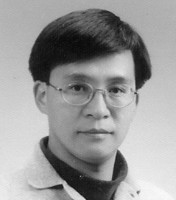
2006 Life Sciences Laureate
Soo Jong Rey
CV
B.Sc. in Science, College of Education, Seoul National University
Ph.D., California Institute of Technology (Caltech), USA
Research Assistant Professor, Department of Physics, Yale University
Research Assistant Professor, Department of Physics, Princeton University
Research Fellow, Institute for Advanced Study, Princeton University
Professor, Department of Physics, College of Natural Sciences, Seoul National University
Reason for Award
Professor Soo Jong Rey, the awardee in the field of life and physical sciences, is a world-renowned expert in string theory, a major area of theoretical physics. He has discovered a novel fact that allows the fundamental principles of the infinitely strong “nuclear force” to be understood in connection with “gravity,” and, in particular, by proposing S-duality and elucidating various non-perturbative phenomena, he laid the foundation that triggered the tremendous academic development known as the “Second String Theory Revolution.”
In recognition of these outstanding achievements, Professor Soo Jong Rey has already received highly prestigious awards worldwide, including the J.J. Sakurai Prize, the ICTP Prize, and the Bessel Award from the Humboldt Foundation in Germany, and he has been elected a Fellow of the British Physical Society for life.
Furthermore, he has served as an editorial board member of leading international journals in string theory and gravity, including Classical and Quantum Gravity and the Journal of High Energy Physics. Professor Soo Jong Rey is expected to continue leading the international academic community in this field and play a unique role in elevating the status of the Korean physics community on the global stage, which led to his selection as an awardee.
Acceptance Speech
First, I would like to deeply thank Mr. Kyung Ahm, the Foundation, and the esteemed members of the selection committee for bestowing upon me the undeserved honor of this award. Standing here in this moment of glory, I find myself reflecting on the path of research I have walked over the past thirteen years—solitary, lonely, and yet again, lonely—since returning to my home country.
If it aligns with the intentions of Mr. Kyung Ahm, the Foundation, and the selection committee, I wish to devote the entire prize to the shadowed corners of our society, where human dignity is imperiled, and to the cause of social justice. Thank you.
As a result, the place for creative intellectual activity in pure science has been thoroughly neglected in this land. What has been our temporal position? Certainly, the magnificent civilizations of humanity—the Tigris, Euphrates, Nile, Yellow, Indus, and Ganges rivers—did not emerge along the Han, Nakdong, or Geum rivers. While we felt ashamed of our material poverty, we were not even slightly conscious of the fact that, in terms of spiritual culture, we produced not a single mathematician of historic renown. Over the past millennia, aside from isolated cases, we have merely followed, not led, the progress of humanity, and yet, the unnatural gestures of exaggerating and displaying national pride continued. Consequently, rationality, logical thinking, predictable commonsense, and the maturity of our social community did not fully blossom in this land.
Science, scientific thinking, and creative scientific activity cannot flourish in a society lacking these elements—a truth that world history clearly demonstrates. Just as ordinary and superior culture coexist within the humanistic tradition, in the realm of scientific culture, philosophy and pure science occupy the central upper echelon. Yet, facing the reality of our society, where pure science is rigorously overlooked and research funding is inadequate, my past research endeavors have been profoundly solitary. The modest achievements I have accomplished were possible primarily because humanity’s great giants—Newton, Maxwell, Einstein, Feynman, and Hawking—preceded me. What I have done was merely to stand on their shoulders and gain a slightly broader perspective.
Nonetheless, awarding me this prize acknowledges that my efforts align with the common good, recognize the value of pure science as a creative upper culture, and at the same time, serve as a reminder to persist in pure scientific research and guide the development of human civilization based on rationality, logical thought, predictable commonsense, and mature social communities.
In the future, if another young Korean seeks to gaze further toward the truth, I will dedicate myself to creating a small but sturdy shoulder they may stand upon. Steve Jobs, the founder of Apple, once said, “If I had the chance to meet a great teacher like Socrates and spend even half a day learning wisdom and truth, I would willingly give up all the tools of civilization I currently enjoy.” To me, more than the honor of the award today, the invaluable opportunity to meet Mr. Kyung Ahm in person, to witness and learn from the profound insights and life values he has attained through his extraordinary efforts, is the greater privilege.
Though some of your children have already been drawn to the mysteries of the universe and embarked upon the path of pure science—a path that offers no financial reward—you have observed and supported them with unwavering faith and guidance. To my parents, I dedicate my gratitude and today’s honor. Lastly, I feel that my glory is complete merely in the recognition that pure science holds its rightful place and value as a supreme culture of humanity.
If it aligns with the intentions of Mr. Kyung Ahm, the Foundation, and the selection committee, I wish to devote the entire prize to the shadowed corners of our society, where human dignity is imperiled, and to the cause of social justice. Thank you.